Electrical towers, pipelines, tunnels, energy infrastructure, and industrial facilities can be difficult to access, located in confined spaces or in environments that are too dangerous or complex for human entry.
In critical infrastructures in particular, an incident can mean lost production and investigation time, additional work, stoppages, legal liabilities, penalties, and significant reputational damage. A recent analysis captures this dynamic plainly: reducing preventive spending does not eliminate the cost, it simply defers it to a later scenario that is far harder to control.
This is where autonomous systems —in the form of robots and drones— can offer a new model of inspection capable of reducing risk to people without sacrificing the need for rigorous oversight.
Drone Patrolling: Eyes From the Air
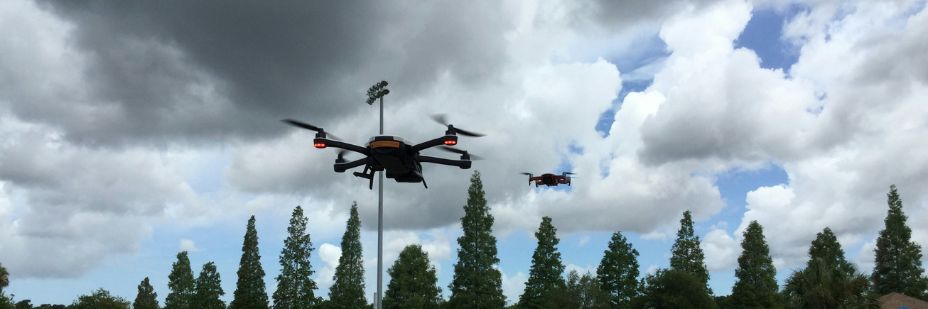
Unmanned systems are becoming an increasingly viable option in this landscape. Early autonomous inspection tools have evolved into modern patrol drones capable of adapting to dynamic environments. When faced with unstable conditions, obstacles, or the need to closely examine a specific element, these systems can capture highly accurate and detailed information about the state of a facility. A standard camera captures high-resolution images and detects visible damage, but additional sensors can reveal hidden information or even anticipate potential vulnerabilities.
Thermal imaging, for example, identifies temperature differences and locates hot spots that signal anomalies before they become visible in a conventional inspection. LiDAR uses laser pulses to measure distances and build three-dimensional representations of the environment — particularly useful for understanding the geometry of a structure, detecting changes over time, or generating digital models. The British company National Grid combines this technology with photogrammetry to create 3D models of its assets and, with the support of thermal sensors, is able to locate hot spots across its network. As a result, the company has already automated part of the inspection of its 21,900 steel electrical towers, generating annual savings of approximately £630,000 and a significant reduction in helicopter use.
Multispectral sensors further expand this capability by recording data across different bands of the electromagnetic spectrum. Combined with AI models, this technology makes it possible to move beyond a simple photograph toward a more comprehensive assessment of an asset's condition.
Terrestrial Robotics: Going Where Drones Can't
Drones offer powerful observation capabilities, but they cannot address every situation. Indoor facilities, tunnels, galleries, and spaces with low ceilings or physical obstacles make flight almost impossible. In these environments, ground robots bring the inspection directly to the point of interest, moving on wheels —faster— , tracks —for stability across any terrain—, or legs —for spaces with complex obstacles—, depending on the characteristics of the environment.
These robotic systems have evolved into true mobile inspection platforms. They can carry high-resolution cameras, thermal sensors, gas detectors, measurement systems, and other instruments, continuously collecting environmental data as they move.
The Abu Dhabi National Oil Company, one of the world's leading energy producers, began deploying a Taurob inspection robot in May 2026 to identify potential gas leaks, unusual hot spots, and other risks at its generation plants. Designed for extreme industrial environments, the robot is equipped with a wide range of advanced sensors, 3D LiDAR technology, and thermal cameras with 360-degree visibility. Those leading its upcoming deployments indicate that these robots will also be capable of lifting and handling industrial equipment.
In tunnels and other underground infrastructure, the combination of mobility and perception is equally critical. A study published in 2025 on quadrupedal robots for inspection in cable tunnels examines how these machines can map their environment, detect obstacles, and adjust their trajectory to navigate narrow, dimly lit spaces with irregular distributions of pipes and cables.
The versatility of these platforms is arguably their greatest advantage. A single robot can combine real-time video with thermal data, environmental readings, and structural measurements, transmitting them all to operators while continuing its route.
Data Integration and Actionable Intelligence

Drones and ground robots are increasingly complementing each other in the field. But the true value of autonomous inspection does not end when the drone lands or the robot completes its route. The volume of data collected must be converted into information that actually supports decision-making. Comparing data gathered at different points in time makes it possible to identify changes and track the progression of an anomaly.
Rather than requiring an operator to manually review thousands of images or measurements, AI models can analyze the data and flag results that deviate from expected patterns. Automated analysis classifies and cross-references these signals and generates alerts based on their potential relevance. Thus, enabling teams to determine with greater precision what requires immediate attention, what should be scheduled, and what can continue to be monitored.
In this way, autonomous inspection systems are evolving beyond a tool for periodic checks and becoming a permanent source of real-time information on the condition of equipment and facilities. Drones and robots carry out the fieldwork; analysis systems organize and contextualize the data; and people interpret the results and decide how to act.
Regulatory, Operational, and Cybersecurity Considerations

Autonomous systems also introduce new regulatory challenges. A drone operating over critical infrastructure must do so within regulated airspace and without posing a risk to other aircraft, facilities, or people. In Europe, drone operations are subject to varying levels of regulatory scrutiny depending on their risk profile, and the assessment of more complex operations is carried out using methodologies such as SORA.
One of the key challenges is operating beyond the operator's line of sight. This is an essential capability for patrolling large perimeters or covering extensive infrastructure. In the United Kingdom, the aviation authority is working to progressively integrate this capability into regulated airspace, with plans to enable routine BVLOS operations from 2027.
There is also a less visible but equally important concern: protecting the autonomous system itself. Drones and robots are increasingly connected and automated, and that expands their attack surface. An intrusion could affect communications, navigation, inspection data, or even the operation of the device itself. The US NIST has specifically flagged these emerging risks in unmanned systems used for critical tasks such as infrastructure inspection.
Security must therefore be built into these systems from the design stage, controlling who can access them and maintaining mechanisms that allow operators to regain control when something does not function as intended. The US CISA already includes drone cybersecurity among the measures required to manage the risks these systems can introduce into critical infrastructures.
Autonomous machines are being deployed to reduce human exposure to risk. But the more important the tasks they perform, the more urgent it becomes to ensure they are safe, reliable, and always under control.