The last article concluded that the next big step forward in AI is not just better implementation, but also a change in the way AI reasoning works. Even though today's systems can do amazing things, they are still fragile, cannot see the bigger picture and do not always make good decisions when things do not go as planned.
Recursive meta-cognition is a significant step beyond these limits. It lets systems check their own thinking instead of just making predictions. This shifts AI from optimizing performance to self-monitoring, enabling it to adapt to new information and generate more reliable professional-level judgments.
What Is Recursive Meta-Cognition?

Meta-cognition is the process of monitoring and controlling one's thoughts. In AI research, this theory is becoming more linked to systems that check their own competency and adapt their strategy when situations change. In that way, recursive meta-cognition is a loop that repeats itself.
The system does more than give an output once. It also checks that output, goes back over its reasoning and improves its next step depending on what it learnt from the last time. Recent research on metacognitive agents, particularly the MUSE framework, articulates this concept in terms of self-awareness and self-regulation that enhance the performance of autonomous systems in novel or out-of-distribution contexts.
From Prediction to Reflective Reasoning
That is the main distinction between recursive meta-cognition and the way most large language models use AI to reason. Language models based on transformers are trained to predict the next token in a sequence.
This makes them good at predicting patterns, but not necessarily at judging themselves. Researchers are increasingly citing this constraint as evidence that advances in sophisticated systems will require a transition from next-word prediction to more generalized reasoning.
Recursive meta-cognition offers a more contemplative approach. It is not enough to merely come up with an answer. It also has to decide if it is logically sound before moving on. Researchers using structured self-reflection frameworks such as Relexion have demonstrated that incorporating feedback loops can enhance performance in reasoning, coding and decision-making.
Why Recursive Meta-Cognition Changes the Trajectory of AI
Expertise is more than just about remembering things. For instance, a doctor might need to double-check a diagnosis, putting an assumption to the test and thinking about whether a different explanation fits the facts better.
The goal of recursive meta-cognition is to help AI systems be more self-critical in this same way. Instead of only making predictions, the model is challenged to perform an internal review, akin to ‘second-guessing’ itself. It should review its own process, identify when it is unsure and change before it makes a mistake.
This idea is more than a better algorithmic shortcut. It shows a real change toward AI systems that can learn from their mistakes and alter their reasoning.
How an AI Learns to Self-Correct
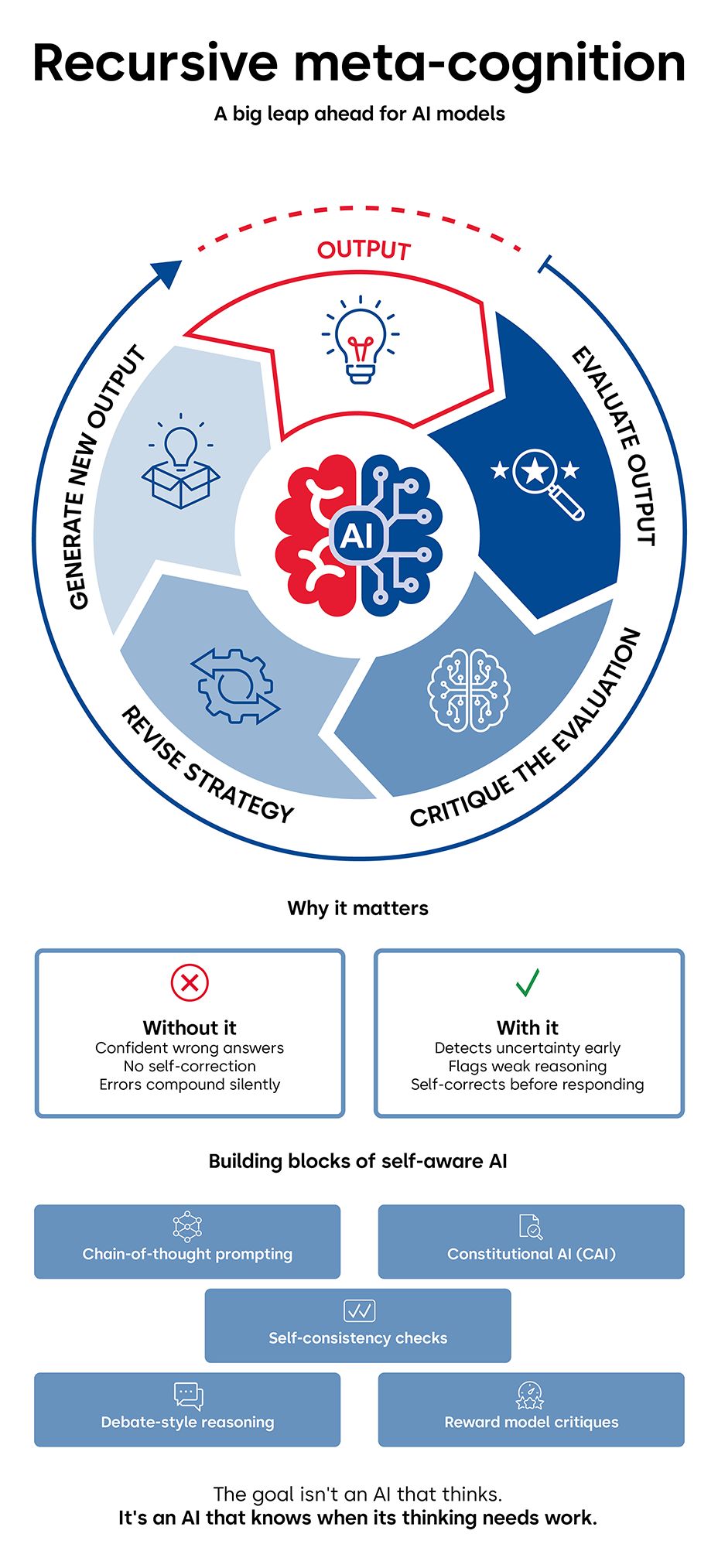
Recursive meta-cognition enables an AI system to enhance its thinking rather than producing a single prediction through a structured internal feedback loop. The system does not accept the first answer as final. Instead, it creates, evaluates and improves.
This recursive workflow adds internal oversight that resembles how experienced professionals check their assumptions, revisit prior phases and confirm their findings before acting. The process typically unfolds as a three-step repeating cycle.
Initial Output
The system produces a first-pass solution based on the context, available training signals and accessible limits. At this point, the behavior is similar to that of a standard large language model, making a reasonable guess based on what it learnt during training.
Self-Critique
Then, a meta-reasoning layer checks the answer against internal standards, including logical correctness, meeting constraints, levels of uncertainty and other possible solutions. The system does not just take the response at face value, but tests whether its rationale holds up under closer examination.
For instance, using techniques such as Chain-of-Thought (CoT) Prompting, where an AI is guided to show its reasoning step by step before arriving at an answer, rather than jumping straight to a conclusion. Instead of "the answer is X," it works through "first… then… therefore… X." Or also Constitutional Artificial Intelligence, a training method where an AI is given a set of principles — a "constitution" — and then asked to critique and revise its own outputs against those principles, before a human ever reviews them.
Iterative Refinement
The critique is then incorporated into AI’s reasoning process to produce a better second-pass answer. Reflexion is an example of a paradigm that shows how organized reflection loops can help models fix logical errors and perform better on tasks, such as answering open-ended questions and reasoning through arithmetic problems.
Manufacturing optimization systems are already affected by recursive improvement. During model creation, Google DeepMind's AlphaEvolve system performs iterative self-improvement. This has sped up some machine learning optimization jobs by 1% at scale and reduced computing power across large datacenter fleets by 0.7%.
These findings show how recursive evaluation loops improve systems' reasoning, a critical characteristic of meta-cognition. This differs from increasing the datasets or the number of parameters.
Applications of Recursive AI

Recursive meta-cognition goes beyond technology. Instead, it alters AI in circumstances with several options. Recursive self-evaluation systems become analytical partners, helping with dynamic problem-solving when situations change and assumptions must be evaluated in real time. This transition from predictions to adaptive thinking can improve reliability in high-stakes situations.
Expanding Creative Optimization in Architecture and Design
Because AI can serve as an assistant, automating tasks and offering design options, it can boost creativity, efficiency and optimization in ways never seen before. In architecture, for example, recursive evaluation lets systems improve conceptual designs by comparing them against structural restrictions and building codes, rather than simply showing a single fixed suggestion.
Adapting to Novel Threat Conditions in Cybersecurity
Threats evolve faster than static rule-based safeguards can. Reflective reasoning loops allow AI systems to analyze new attack patterns, reconsider defensive assumptions and adjust mitigation techniques. This example is already trending in the business world. According to recent reports, 32% of organizations use AI-powered security, saving about $220,000 in breach expenses.
Recursive reasoning enables systems to assess whether a threat matches known signatures and whether defensive measures remain effective as attackers adapt their methods, strengthening this path.
Supporting Iterative Discovery in Scientific Research
Recursive reasoning is also changing how scientists operate, enabling AI systems to generate hypotheses and adjust the course of experiments as new evidence emerges. ChemCrow, for example, is an autonomous research system that demonstrates how language model agents can use tool-assisted reasoning loops to plan and refine chemistry experiments repeatedly.
From Prediction to Self-Aware Reasoning

AI's recursive meta-cognition is a change from coming up with solutions to judging and refining them through systematic self-reflection. As these capabilities grow, systems will become increasingly important in workflows where speed and judgment are both critical.
The next step in AI growth will depend on how well systems learn to monitor and improve their own reasoning, focusing on the critical need to establish trust and reliability between AI systems and their human users.