
Humanoid robotics—human-shaped robots equipped with arms, legs, hands, and cognitive systems powered by artificial intelligence—is reaching a tipping point. For years, these systems were mostly seen at technology fairs or in research labs, demonstrating the ability to walk, run, or interact in basic ways with people, but still far from sustained practical use.
Early humanoids showed that it was possible to replicate certain aspects of human movement and interaction in controlled environments. Their value was largely experimental: validating sensors, perception algorithms, and control systems that could later be transferred to platforms with more direct commercial application.
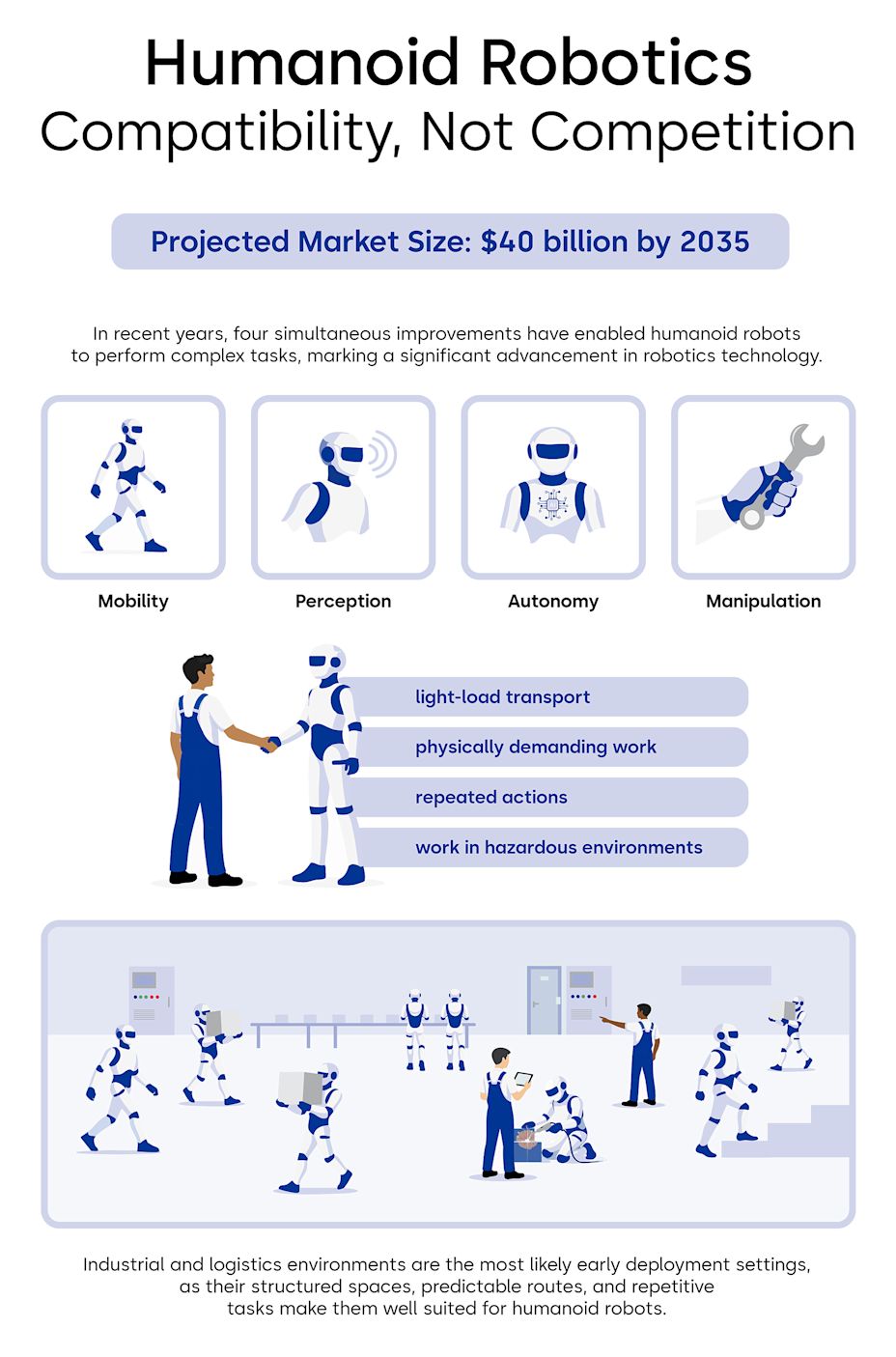
Today, the conversation has shifted. The humanoid robotics market is currently valued at between $2 billion and $3 billion and is projected to reach $40 billion by 2035, with growth potential estimated at $200 billion. The technical and business community is no longer debating whether robots can walk like humans, but where—and how—they can generate real value.
The discussion is moving beyond tech spectacle toward practical, measurable questions: Which tasks can be reliably automated? What costs and safety standards are required for industrial use? How do autonomous systems integrate into an existing human workforce? And what comes next?
What has Really Changed in Humanoid Robotics
In recent years, progress has become more integrated. There have been simultaneous improvements in mobility, perception, autonomy, and manipulation, enabling humanoid robots to perform complex tasks with minimal human intervention. Some models are already being tested in manufacturing plants for activities such as internal transport, material handling, and support for assembly processes.
This recent leap is not due to a single breakthrough, but to the convergence of several key trends—above all, the evolution of AI models from highly specialized systems into architectures capable of generalizing, adapting, and making decisions in changing contexts. Robots no longer rely exclusively on pre-programmed rules; they can learn from real-world data, simulations, and human demonstrations.
Physical AI and Advanced Hardware

The emergence of “physical AI” allows these systems not only to perceive their environment, but to reason about it and act accordingly. By integrating vision, language, and action within machine-learning frameworks—supported by new generations of high-performance computing hardware—the gap between understanding and execution is narrowing, enabling more flexible behaviors in spaces designed for people.
At the same time, hardware is no longer the main bottleneck. Advances in sensors and kinematic control have enabled smoother, more precise movements, safer balance, and greater ability to manipulate objects. Bipedal walking remains a complex feature, but it is far more stable than it was a decade ago—expanding the range of tasks humanoids can realistically perform.
From General Capability to Useful Tasks
One of the most relevant shifts in humanoid robotics is the gradual move away from the ideal of a robot that can do “everything.” This transition is less about technological limits than about a practical conclusion: absolute versatility is expensive, difficult to certify, and complex to integrate into real-world processes. By contrast, well-defined roles make it possible to measure performance, justify investment, and comply with safety standards.
For this reason, most humanoids operating outside the lab today do so in clearly bounded roles, avoiding open-ended scenarios or unpredictable tasks. This approach allows teams to evaluate performance, detect failures, and scale adoption without introducing systemic risk. Many humanoids remain in pilot programs precisely because they still require a high degree of control to operate reliably.
The appeal of the humanoid is not only its resemblance to humans, but its physical compatibility with the world as it is built. These robots can function in spaces designed for people without forcing infrastructure redesign. Stairs, doors, hand tools, and circulation routes built around human bodies become a practical advantage compared to specialized robots that require adapted environments.
Where You’re Most Likely to See Them First
Industrial and logistics environments are the most likely early deployment settings. These are structured spaces with predictable routes and repetitive tasks, where humanoids can handle light-load transport and reduce physical strain—especially when work involves repeated actions and interaction with human-scale infrastructure.
Humanoid systems also have potential in maintenance and inspection within hazardous environments. In sectors such as energy or petrochemicals, robots can enter confined or risky areas, collect visual data, and support monitoring tasks without exposing technicians to danger. Industrial robots that perform dangerous tasks can make work environments safer, but only in advanced and well-protected economies, according to this study published in February 2025.
In care settings, the potential exists, but with clear limits. Humanoid robots will not replace clinical staff, yet they may support basic, low-specialization tasks. This could become one of the most visible and socially accepted areas of adoption.
Across all these contexts, phased deployment will be essential: controlled pilots, operational validation, and progressive expansion only once requirements for reliability, cost, and safety are consistently met.
Some Restrictions Continue to Slow the Pace

Despite recent advances, several fundamental limitations still shape the pace of large-scale humanoid adoption. Energy is one of the most obvious. Bipedal walking is inherently inefficient, and most current humanoids can operate only for limited periods because they consume far more power than wheeled platforms or fixed robotic arms. This constraint forces a rethink of shifts, infrastructure, and operating models.
Cost remains another critical factor. Humanoid prices have dropped sharply over the past decade—from around $3 million to roughly $100,000 per unit. Yet even as the ecosystem of startups and major manufacturers grows rapidly, with investment accelerating innovation and competition, maintenance, certification, and integration are still expensive. The long-term business case will depend on whether humanoids can outperform—or at least compete credibly with—simpler automation alternatives.
Regulatory and ethical challenges add further complexity. Questions remain around responsibility in the event of failures or damages, the impact on employment and worker transition, the appropriateness of delegating critical tasks to autonomous systems, and how to protect privacy and avoid bias in robots equipped with extensive sensors and AI.
An Evolution, not a Leap

The next phase of humanoid robotics will not be defined by spectacular demonstrations, but by quieter—and more decisive—indicators: reliable uptime, integration with existing systems, predictable maintenance, and safe collaboration with humans.
There is unlikely to be a single “iPhone moment” that suddenly transforms factories, hospitals, or homes. Instead, progress will be gradual, driven by incremental improvements and real-world validation: first pilots, then partial deployments, and only over time wider adoption. Ultimately, it will be the progressive combination of autonomy, reliability, and cost reduction that determines how fast humanoid robots move from promise to everyday reality.