
There was a time when stadium security was measured exclusively by the height of its fences and the number of personnel deployed at entrance turnstiles. Every access point became a bottleneck: long queues, fans searching for a crumpled ticket, and operators manually validating thousands of codes against the clock.
The sports industry has been grappling with this tension between protection, technology, and spectator experience for years. A study drawing on the views of more than 150 security managers at sports venues across the United States identified the most pressing challenges they face: managing access flows, coordinating increasingly integrated technology systems, and the constant pressure to reduce wait times.
Why Traditional Access Control Is in Question

Following incidents such as those at the Euro 2020 final at Wembley (London) — where thousands of ticketless fans forced their way into the venue and overwhelmed access points — many operators have begun pushing for a transition from static security to intelligent models. The underlying logic is straightforward: verifying identities before a spectator ever reaches the turnstile is far more effective than managing the problem at the gate, and it aligns with the broader need to optimize crowd flow dynamically.
Smart Ticketing Transforms Security and Experience

Smart ticketing and contactless access systems are built on technologies such as QR codes, RFID wristbands, NFC, and mobile apps. Rather than waiting for a manual review, visitors scan their digital tickets at automated entry points.
This system turns each ticket into a unique digital identity embedded within the event ecosystem. Every interaction generates data that can be used to anticipate crowd flows, optimize access, allocate operational resources, and improve venue security. It also enables a direct and continuous relationship between organizer and attendee before, during, and after the event.
With this dynamic credential, operators can manage VIP access and movement in restricted areas, and build a tailored digital experience for each attendee. One notable example is the FAN ID that FIFA is deploying at the 2026 World Cup: a free, personalized card that turns a smartphone into a gateway to exclusive experiences and content, while facilitating interaction between organizer and fan.
Additionally, ticket fraud has always been one of the great logistical vulnerabilities of large events. Traditional PDF tickets and screen-captured barcodes were easily duplicated and sold outside the venue. Smart access systems address this directly: rather than simply scanning a barcode, they require a cryptographic authentication protocol in which the entry code is silently rewritten every 15 seconds. If a fan attempts to use a screenshot or recording, the static image will fail because the time-sensitive cryptographic token has already expired.
The Expanding Perimeter: How Stadium Security Is Moving Outward
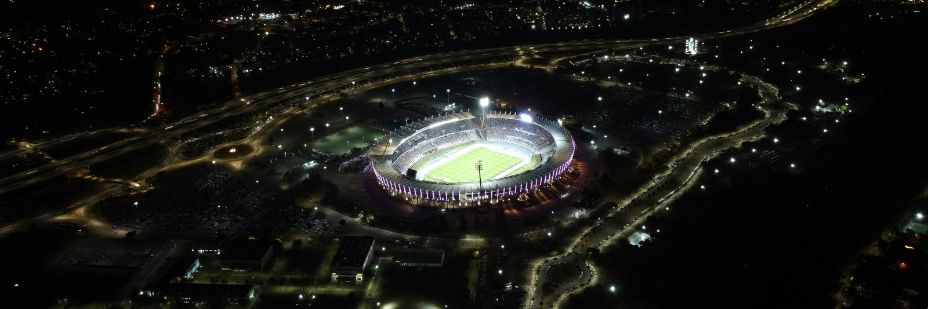
Large sports venues are progressively extending their security perimeter outward through multiple layers. For the 2026 World Cup, FIFA regulations mandate two concentric security perimeters that divide the venue into three main zones.
The first is the public area, the immediately surrounding space not under the control of the stadium authority. The second is the outer perimeter, designed to prevent unauthorized access to the surroundings and create a safe buffer between the stadium and any potential threat. The third is the inner perimeter, where final ticket verification takes place. The precise distance between the two perimeters is determined in coordination with local authorities, taking into account the available space on site as well as general and specific security risks.
The outer perimeter serves several critical functions. It is recommended to be enclosed by 2.5-meter fences, monitored by cameras and security posts, and equipped with protection measures against hostile vehicles. Its design focuses not only on physical barriers, but on intuitive and progressive routing that ensures full capacity at entry and exit points, adequate queuing space, and unobstructed circulation. Clear signage, separated entry and exit flows, staggered control points, and generous circulation areas help prevent dangerous concentrations even at peak arrival times. The goal is not simply to move people through but to reduce uncertainty and maintain a constant sense of direction and forward movement.
Achieving this requires disciplines that once worked in isolation to collaborate from the outset. Architects, urban planners, security consultants, venue operators, and local authorities are now jointly involved in perimeter planning, assessing pedestrian flow, traffic management, evacuation scenarios, and crowd behavior as components of a single integrated system.
Invisible Security: Balancing Protection and a Frictionless Experience

Beyond protecting the venue, the goal is to do so without disrupting the fan experience.
The impact of friction on spectator satisfaction is already measurable. The prevailing trend points toward a security model built on near-invisible access — one in which the user does not need to stop, take out their phone, or manually present credentials.
Operators understand that every bottleneck negatively affects both the perception of the event and spending inside the stadium. The more time a spectator spends waiting at entrances, checkpoints, or queues, the less time they have for restaurants, retail, and experiences within the venue. The focus has therefore shifted from simply verifying credentials to doing so in motion and in real time — a change that meaningfully accelerates the pace of entry.
This evolution is also reflected in the physical security approach taken at major events. At the 2024 Champions League final at Wembley, a more robust and layered perimeter system made it possible to manage access without overwhelming the spectator experience, thanks to successive control layers and closer coordination between private security teams and law enforcement.
The next generation of stadium security is being designed around predictive, fast, and reliable access systems capable of addressing emerging challenges such as tailgating, which has become one of the most significant blind spots in venue security. AI-based biometric authentication systems can detect this type of behavior automatically and generate real-time alerts.
It is in this balance between efficiency, discretion, and technology that the smart stadium of the future is taking shape.