
Throughout history, access control systems have evolved at the pace of technology and security needs. Purely physical solutions and mechanical devices gave way to digital systems, mobile credentials, biometric scanners, and voice recognition. Today, many of these solutions are supported by artificial intelligence, processed in the cloud, and integrated with building management and other smart systems.
In this context of constant evolution, a new question arises: what would happen if access credentials ceased to be physical or biometric and were instead based on cognitive processes? Brain-machine interfaces represent an emerging technology that makes this possibility tangible. They propose a provocative vision of the future in which credentials are not transported or scanned — not even seen — but are generated and validated from brain activity.
Brain-Machine Interfaces: What They Are and Where They Work Today

Brain-computer interfaces (BCIs) are systems designed to read and interpret neural signals and translate them into commands that a digital system can understand. They function as a direct communication channel between the brain and a machine, without the need for muscle intermediation. The system detects neural patterns associated with a particular intent — such as selecting an option or activating a device —, processes them using signal algorithms and machine learning, and converts them into an external action.
There are two main types of BCIs. Invasive interfaces require surgical implants in brain tissue and offer high-resolution signals. Non-invasive interfaces, on the other hand, use external sensors — such as electroencephalography — to capture brain activity from outside the skull. Although they are less precise, they are safer and more accessible, making them the primary focus of much current research.
How BCIs Are Transforming Healthcare Today
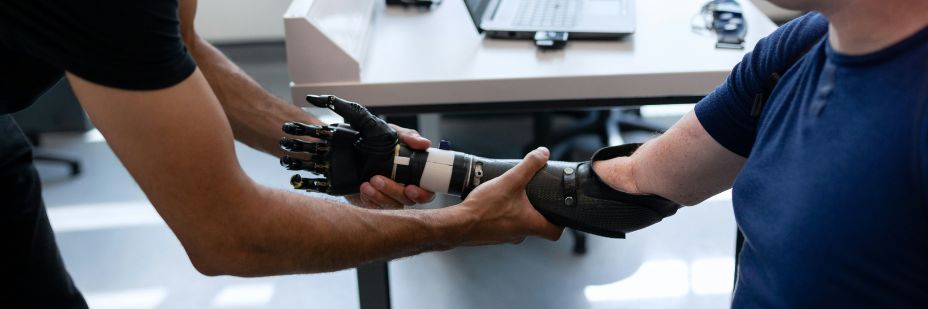
Although it may seem futuristic, brain-machine interfaces are already in use in very specific areas, particularly in the healthcare sector. Their development has been oriented primarily toward neurological rehabilitation and assistance for people with severe disabilities. There are documented cases in which patients with paralysis have managed to communicate by converting brain activity into text — as happened with one ALS patient — as well as research aimed at helping blind people perceive contours and recognize shapes through experimental visual neuroprostheses.
These advances explain the growing interest in this technology, with market forecasts reaching 17 billion dollars by 2026. However, its use remains limited to highly controlled environments with very specific objectives.
From Biometrics to Cognitive Access

Progress in this field opens the door, at least in theory, to access models based on intention or neural patterns associated with conscious decisions. Current BCIs do not "read thoughts" or interpret abstract intentions, but they do allow very specific and trained cognitive responses to be decoded.
This approach introduces a meaningful conceptual difference compared to traditional biometrics. While fingerprints, facial recognition, or iris scans rely on relatively static physical features, neural signals are dynamic, contextual, and far less visible. In theory, this could reduce certain common attack vectors — such as copying or spoofing — since these patterns cannot be observed or reproduced without the active participation of the user.
How BCIs Could Reshape Access Control
Brain-computer interfaces are not going to replace current access systems in the short term, but exploring this field allows us to anticipate possible future scenarios.
In high-security environments — such as laboratories, critical infrastructures, or data centers — BCIs could serve as an additional authentication factor. They would not replace existing credentials, but would add a cognitive layer to validate that certain actions reflect a conscious and authorized intent.
Another potential area is accessibility. BCIs could enable completely hands-free access for people with reduced mobility or difficulties interacting with conventional systems, reducing physical barriers and improving inclusion.
Looking further ahead, they could be integrated into personal devices or vehicles, enabling continuous authentication models based on cognitive patterns. They also invite us to imagine frictionless environments where physical interaction with access systems is minimized and the user experience becomes more fluid.
Navigating the Challenges: Technology, Privacy, and Ethics

This potential comes with significant challenges. From a technical standpoint, the reliability of neural signals remains limited. Variability between users and contexts can lead to interpretation errors — a particularly critical issue in security systems.
Added to this is the question of privacy. Neural data is deeply personal and can reveal sensitive information beyond authentication. Without clear legal frameworks, important questions arise about its storage, use, consent, and ownership. Who controls this data, and for what purposes?
These challenges make clear that any progress in this area must be accompanied by strong ethical principles, responsible governance, and a design approach focused on protecting fundamental rights — including mental privacy and cognitive autonomy.
How Near Is Neural Access Control, Really?

As of today, BCIs applied to access control are not imminent. The hardware remains expensive, impractical, and sensitive to interference. Regulatory frameworks are still underdeveloped, and social acceptance raises valid questions — particularly around technologies perceived as intrusive.
The most realistic scenario in the medium term is a gradual evolution toward hybrid systems: combinations of advanced biometrics, wearables, and intention-based controls, without yet resorting to direct reading of neural signals. These intermediate solutions allow new access models to be explored without abrupt technological leaps.
Rethinking Access in a Cognitive Future

Brain-machine interfaces are prompting us to rethink how we understand identity and access. Beyond replacing a card or a password, they propose a profound conceptual shift: moving from verifying physical traits to validating cognitive processes.
Their true value does not lie in their immediate adoption, but in the reflection they generate. They invite us to imagine access systems that are more inclusive, adaptive, and people-centered. As we look to the future, it is clear that the evolution of access control will depend as much on ethics, trust, and responsible design as it will on technology. Only through this balance will it be possible to build systems that enhance human identity rather than compromise it.