(Image © Groume licensed under the Creative Commons Attribution-ShareAlike 2.0 Generic)
In 2022, the Royal Academy Architecture Awards acknowledged a 92-year-old French architect; one who has completely re- shaped the face of suburban Paris with a whopping 2,000 buildings completed in her career, but was largely unknown internationally: Renée Gailhoustet.
Upon naming Gailhoustet's as the winner of this prestigious award, Farshid Moussavi, Chair of the Jury, praised her prolific and impactful career: “Renée Gailhoustet's achievements reach far beyond what is produced as social or affordable housing anywhere today. Her work has a strong social commitment that brings together generosity, beauty, ecology, and inclusivity."
Philosophy, Form, and Function: Early Life, Style, and Influences
(Image © Guilhem Vellut licensed under the Creative Commons Attribution 2.0 Generic license)
Renée Gailhoustet's path to architecture wasn't a conventional one. Born in 1929 in Oran, Algeria, her initial foray into the world of academia was through philosophy. This early exposure to critical thinking and the exploration of fundamental questions shaped her approach to design later in life.
Nevertheless, her love for form and function eventually led her to the École Nationale des Beaux-Arts de Paris, where she graduated in 1961, to a job market where there were very few women in architecture. The design world often relegated women to a supporting role, diminishing their contributions by labeling them “companion-architects" to their male counterparts. However, even though Gailhoustet also arguably remained invisible, her vision and projects were anything but noticeable.
Gailhoustet's architectural style defied easy categorization. While her early work bore the hallmarks of the Brutalist movement, with its exposed concrete and geometric forms, she wasn't content to simply follow trends.
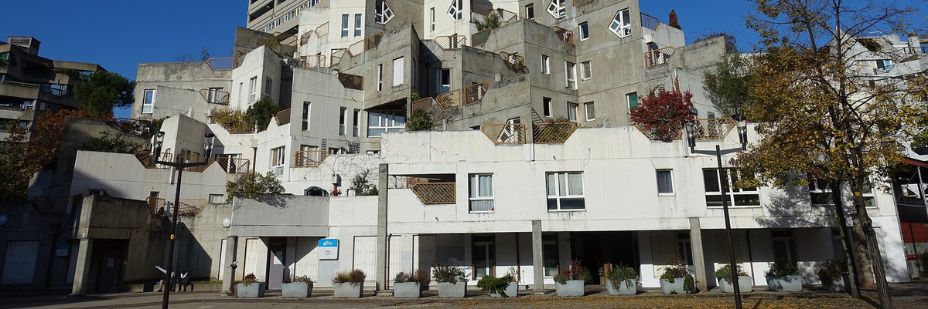
Her true passion lay in crafting spaces that served a social purpose. Functionality and livability for residents were paramount. This manifested in her rejection of look-alike apartment blocks in favor of terraced structures that fostered a sense of community and offered a connection to the outdoors.
Notable Works: A Life Dedicated to Shaping the Parisian Suburbs
As soon as she started to work as an architect, Renée Gailhoustet found her calling in the often-maligned world of Parisian social housing. While her contemporaries were churning out monotonous high-rises, Gailhoustet envisioned a different kind of environment and spent her career championing better living conditions for residents of Parisian suburbs.
Her work on the Ivry-sur-Seine district stands as a prime example. Here, in collaboration with architect Jean Renaudie, she designed a complex that defied the typical tower model. Instead, terraced buildings with open spaces fostered a sense of community and offered residents a vital connection to the outdoors.
The town center of Ivry-sur-Seine, encompassing the Raspail, Lénine, Jeanne Hachette, and Casanova towers, along with the Spinoza complex and terraced apartment buildings like Le Liégat and Marat, all bear Gailhoustet's mark. These diverse structures contribute to the vibrant and community-oriented feel of the district.
Even more remarkably, Gailhoustet was a pioneer in sustainable design. Long before green roofs became mainstream, she incorporated them into her projects. These "living roofs" not only enhanced the aesthetics of her buildings but also provided environmental benefits like rainwater management and improved insulation.
Her commitment to social responsibility and sustainable practices makes her a true forerunner of the modern movement towards socially conscious and environmentally responsible architecture.
"Merci Renée": An Ongoing Legacy of Socially- Conscious Design
Gailhoustet's style was a unique blend of social conscience, human- centric design, and a commitment to sustainable practices.
In her book, “La Politesse des Maison,” the title of which translates to English as “The Politeness of the Houses", Gailhoustet wrote: “Housing is not a product, as developers and technocrats want us to believe. All inhabitants can enrich this vocabulary and engage in a conversation with the architects – those craftsmen of difficult matter: Space.''
To prove her commitment and passion for social housing, Gailhoustet lived in the projects she has worked on since the 1960s until her death in 2023 -- just a few months after winning the 2022 Royal Academy Architecture Award.
Gailhoustet's impact in the social housing communities she has built has been so heartfelt and deep, Le Monde reports that the day after death, the residents gathered, candles in their hands, under a banner that read: "Merci Renée".