The vault, like the arch, channels vertical loads sideways and prevents bending. But while the arch resolves that challenge along a line, the vault does so across a surface — for the vault is, in essence, a succession of arches, one behind the other, forming a tunnel. Or, put another way, it is an arch in motion, replicated and extended along a single path.
A stone or brick vault covers a vast area compared to the small pieces that compose it. To stand without collapsing, it must adopt the only possible form: as it happens with the arch, pure compression dictates its curvature. The cylindrical roll is what keeps the entire structure in balance.
A Dynamic Concave Space
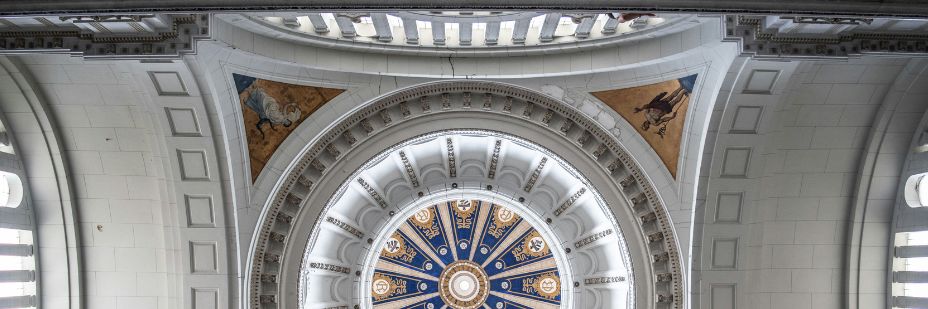
Unlike the dome, which has a static vocation, the vault is clearly oriented — it imposes movement. What it covers is not merely a surface, but a direction. Vaults define routes: arcades, cloisters, the naves of churches leading toward the altar, ambulatories... After all, a vault is a wandering, a stroll, a walk beneath a welcoming false sky — an image of the celestial vault.
Concave and elongated, the vault seems to draw us upward and forward at once. It evokes a kind of weightlessness, as if its concavity were pulling us in while its orientation propels us toward its farthest point.
Learning from Complexity
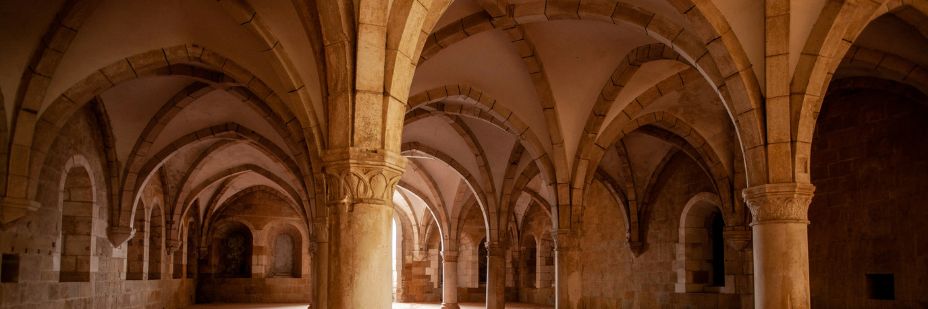
The essential vault is a straight semi-cylinder — a clean curved surface with a single direction of curvature. In its simplicity, though not in its simplism, lies its elegance. But if there is one thing human beings have always enjoyed, it is complicating their lives — hence the creation of ribbed vaults, with inserted ribs, divisions, segments, and branches. There are vaults that rest upon other vaults; vaults of diamonds, lunettes, or cloths; vaults that open like flowers and dissolve like layers of puff pastry.
Sometimes vaults have grown complex or hybridized out of necessity — to admit light, to cover irregular plans, or to resolve difficult junctions at varying heights. At other times, it has been out of pure whim or pride, the delight of showing off. In the end, there are countless types of vaults — their variants, and the variants of their variants. The most characteristic ones include:
The barrel vault, as mentioned, is the elemental type: a straight, circular semi-cylinder. The next refinement is to sharpen the curve, evolving from semicircle to parabola — structurally more efficient, but also more slender and more eager for elevation. In Gaudí’s architecture, numerous examples of pointed vaults can be found, such as in the attics of Casa Milà and Casa Batlló, or in the Col·legi de les Teresianes.
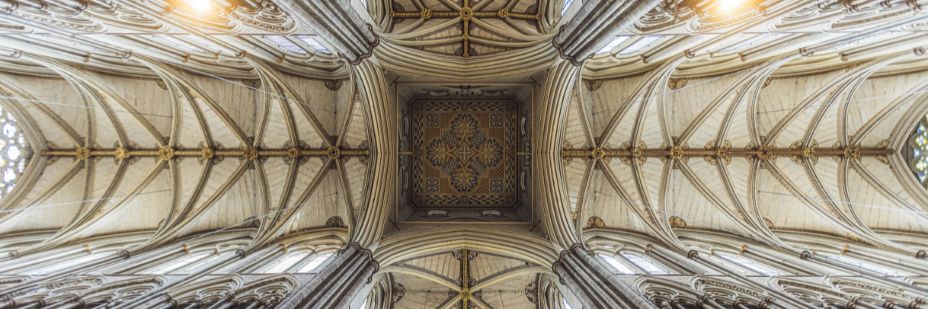
The ribbed vault (or groin vault) incorporates both transverse and diagonal arches, forming star-like patterns that are not merely decorative but carry the interior lines of force. Notable examples can be seen in the cathedrals of Reims, Astorga, and Winchester, among many others.
The lunette vault is laterally interrupted by smaller vaults that cut into it to create openings for windows. Famous examples include the Sistine Chapel in Rome, the Church of Saint-Sulpice in Paris, and the Main Hall of the Pontifical University of Salamanca.
The annular vault curves in plan, forming a semi-torus rather than a semi-cylinder. Renowned examples can be found in the Palace of Carlos V at the Alhambra in Granada, and in the Colosseum in Rome.
Resisting Thrust
Like the arch, the vault has been used since the most remote times. Its builders, guided first by intuition and later by trial and error, achieved extraordinary mastery in its construction centuries before its operation was understood scientifically in the nineteenth century.
The success of the vault depends not only on shaping it so that its compressive forces remain contained, but also on resisting the unwanted lateral thrusts that such curvature inevitably generates. The brilliance, grandeur, and elegance of a vault owe much to its long-suffering supports.
The vault’s efficiency imposes a strict condition — and a heavy responsibility — on the elements that sustain it. The graceful path of compression traced by its delicate curve ultimately ends in a powerful horizontal thrust, which bears down on the walls or vertical supports beneath it. These, in turn, must be reinforced with buttresses or other elements capable of absorbing and dispersing the strain.
In a sense, the celestial vault, that sublime and luminous ether of our dreams, can function only if it keeps its feet firmly on the ground — if it is securely anchored and countered by heavy, grounded forces. It remains a fitting metaphor for architecture itself, and for life: our desires and aspirations may soar high, but they endure only when resisted, balanced, and supported by what is solid.