A flying buttress is an external structural element that redirects the thrust of a vault toward separate points of support, thereby freeing the walls. Without such devices, vaults transmit their compressive forces downward along their curvature and into the walls that support them. During this process, however, the horizontal components of these forces tend to push the walls outward, threatening to open the vault and destabilize the entire structure.
The Stabilizing Weight

The ancients countered these thrusts with mass — walls that were very thick and heavy, reinforced by large buttresses attached directly to them. In other words, the only known way to resist the destructive thrust of a vault was through weight. Weight stabilizes.
Imagine a stack of books on a table. A light slap from the side can easily knock it down. Now imagine the same stack with a heavy object or a person sitting on top. The same slap will no longer topple it — it would take far greater force. Likewise, the earliest and most intuitive solution to resist a horizontal force in a vertical structure was simply to make it heavier.
The Brilliance of a Lightweight Solution
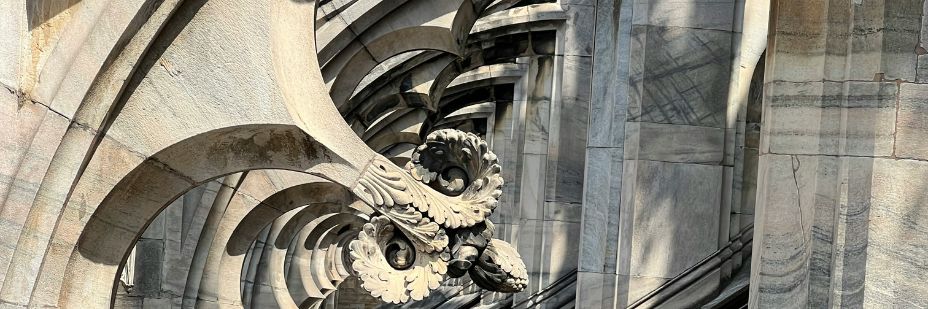
With the arrival of the Gothic era, master builders conceived a brilliant idea to solve this age-old problem. Instead of stubbornly resisting the lateral thrusts — as though holding shut a heavy door — they realized it was wiser to let the force pass, to guide it along a path, and to divert it elsewhere.
Thus they invented the flying buttress: a hybrid between an inclined prop and a half-arch, light and slender, that carried the thrust toward vertical supports set apart from the walls — known as abutments.
The problem was not eliminated but relocated — which was no small achievement. Heavy and less graceful elements were still needed to counter the horizontal forces of the vaults. Yet these massive supports were now detached from the walls, which were suddenly liberated from the burden of those pressures. Freed at last, the walls could rise higher and thinner, their solidity transformed into lightness.
No longer bound by their former weight, they could now be pierced by vast stained-glass windows, flooding interiors with color and light. Thus the Gothic space became larger, lighter, more open, and more radiant than the Romanesque — all thanks to the ingenious invention of the flying buttress.
The Emissaries
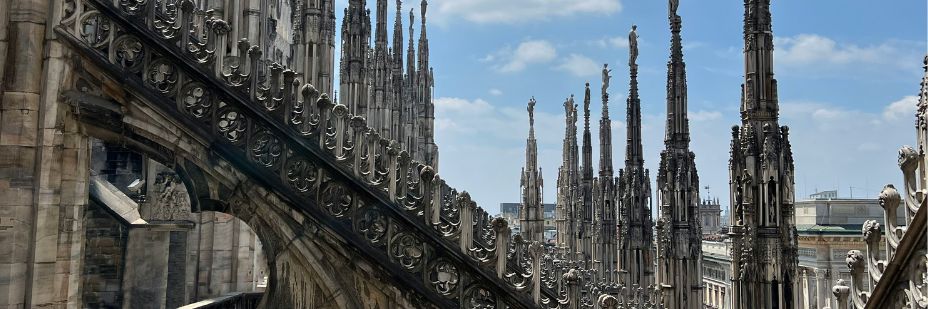
But it didn’t stop there. The mission of the flying buttress evolved into something even more fascinating. A single line of buttresses could channel the thrusts toward the massive, rough abutments. Yet, to improve upon that initial single-line system, builders devised a simple but brilliant idea: two successive lines of flying buttresses.
The first line collected the thrust from the vault and transmitted it to a row of abutments. These, in turn, absorbed only part of the force and left the remainder to a second line of flying buttresses, which then carried it farther outward to another set of supports. In this way, the pressure exerted by the vault was divided, diffused, and displaced, gradually dissolving its intensity.
As a result, the abutments no longer needed to be excessively large or heavy, allowing the entire structure to share the same lightness and elegance. No longer were some elements condemned to coarseness and massiveness so that others — the walls — could appear refined and airy. Now, the loads were distributed more harmoniously, and every part of the system could participate in the shared grace of equilibrium.
A succession of flying buttresses is thus a chain of emissaries, each distributing the effort, involving more of the structure in a common task. They delegate part of their mission — or rather, they each perform a portion of the work and pass the rest along to others.
Flying Buttress Specialization
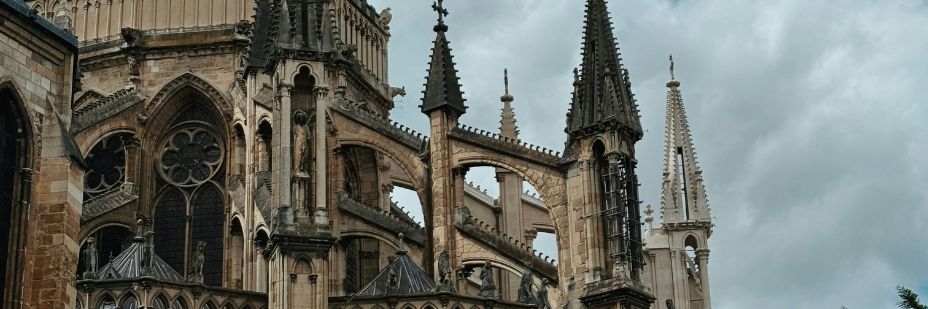
Speaking of delegation, there are cases in which flying buttresses become specialized, each addressing a specific type of force that they then distribute in turn. This can be seen in the Cathedral of Reims, where two families of flying buttresses stand close together, one above the other. The lower tier absorbs and redirects the horizontal thrusts of the vault, while the upper tier counteracts the force of the wind.
And how did they know which was which? The master builders, lacking even the slightest notion of structural calculation, possessed instead a perfect intuition for the behavior and distribution of thrusts.
The Calculation Came Long After the Solution
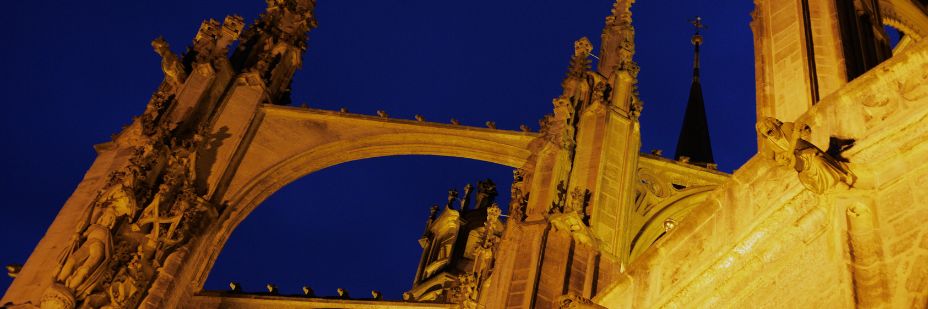
As with other masterfully conceived structural elements, it took many centuries before anyone could formally calculate the performance of flying buttresses and verify — once again — the illiterate brilliance and spontaneous ingenuity of those early builders.
One of the first to estimate and scientifically explain the stresses resisted by flying buttresses was German architect Georg Gottlob Ungewitter, in the mid-nineteenth century — nearly seven hundred years after the first of these structures had already been built!
It never ceases to amaze us that, centuries before possessing the mathematical tools to size and measure them, those lucid craftsmen had already invented these fundamental elements — establishing a collaborative and supportive system in which every component plays its part, receiving and transmitting effort for the good of the whole.