Dictionaries define the term “dome” as a type of “vault,” and in some cases treat the two as synonyms. Yet, both constructively and spatially, they are very different elements. If the vault is a succession of arches extended along a line, the dome is an arch in revolution, spun around its axis of symmetry.
A Symbolic Contradiction
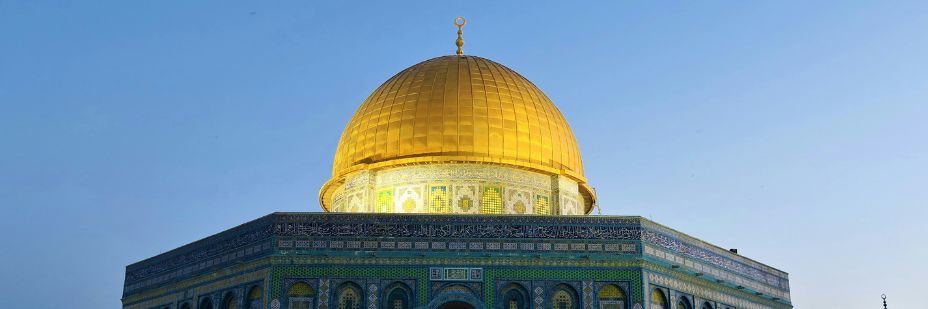
The dome par excellence is the blue sky. Lying in the countryside on a clear summer night, we gaze upward feeling ourselves at the center of everything — and there it is: the vast hemisphere that shelters us, yet also dwarfs us, and at times even threatens us.
From that primal experience, humans have long sought to construct a false sky. A gentler, safer one that would not rain upon us, nor send lightning or hail. A domesticated sky, controlled and protective, built to defend us from the force of nature.
Thus, every dome is a contradiction: we shield ourselves from the power of the heavens but at the same time we invoke them. Some domes are painted with stars, while others are crowned with a lantern or oculus through which sunlight enters and takes command of the space — just as it does in the true sky above.
Horror Vacui or The Vertigo of Empty Space
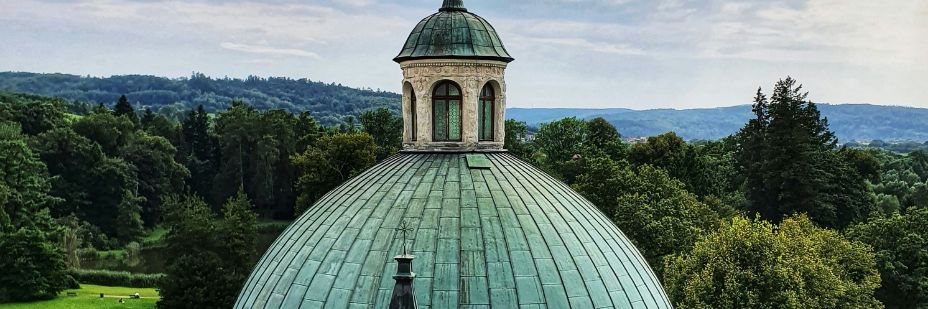
Unlike the vault, the dome is static. It creates a concave space, frozen in its horizontal span yet dynamic in its vertical reach.
When you finish climbing the octagonal drum of the dome of Florence, you already find yourself at a considerable height. There, before beginning the ascent between the two shells of the dome itself, you look down into the church — and realize you are far higher than you imagined while climbing blindly.
When you look downward, the depth amplified by the geometric drawing on the floor, vertigo grips you. Then you look upward — and feel it again, even stronger. You fear falling to the earth as much as falling into the heavens. Between these two opposing pulls, it seems that if you leapt into the void, you might float suspended in the middle.
But when you look at a dome from below — which is how we most often experience it — you feel only its ascending tension. It is as if you were standing inside a vast metaphysical egg, an orb, a maternal womb, where even among a crowd (as in the Pantheon in Rome) you are suddenly alone in the void. You feel not only the architectural space in its purest essence, but also your own belonging to it, and your relationship with something far greater than yourself.
Playing with Dimensions
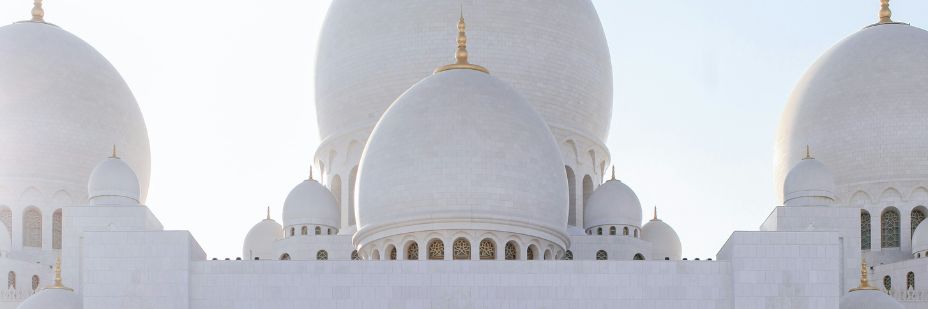
As with the arch and the vault, we once again speak of the paths of compressive forces. But in the dome, something extraordinary occurs — something that belongs to the third dimension.
The arch and the vault curve in only one direction; therefore, we cannot imagine them open at the top, without a keystone, for such an interruption would break their continuity, causing them to collapse. Yet in the dome, this very interruption is not only possible but common: a circular opening at the top, often crowned — to our astonishment — by a heavy lantern, and still the dome does not fall.
This is because the generating arch, the curve that revolves around the vertical axis, finds closure in another dimension. Were it isolated or arrayed in a line, it would collapse; but once rotated, it becomes self-sustaining, its upper void enclosed by a compressed circular ring that holds everything in balance.
A Typology That Evokes the Known Universe
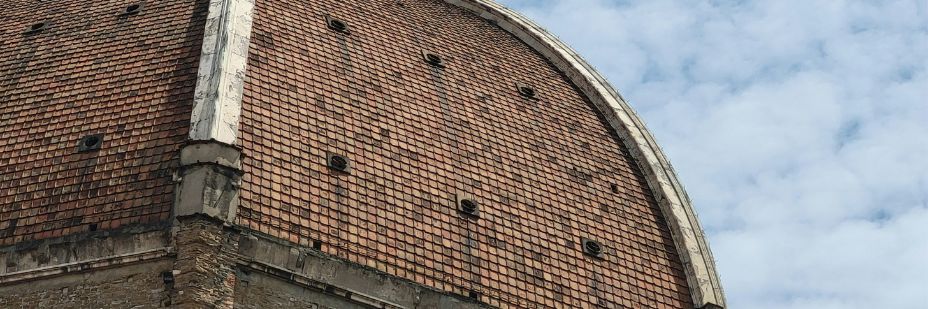
The basic dome, the primordial one, is the hemispherical dome — a semicircular arch rotated around its vertical axis. From this fundamental form emerge variations with pointed or parabolic generating arches, likewise spun in revolution.
Things become more complex when the dome’s plan is not circular, but polygonal, elliptical, or composite. This greatly complicates both construction and spatial perception, yet it also gives rise to remarkably creative solutions:
Dome on pendentives: From a square floor plan to a circular dome, achieved through four “spherical triangles,” one in each corner. Among many examples, the Hagia Sophia of Constantinople stands out for its beauty and elegance.
Dome on squinches: From a square plan, an octagonal dome is formed by flattening the corners with squinches — like truncated cones or half-domes. A notable example is the Baptistery of San Giovanni in Fonte, Naples.
Polygonal dome: From each vertex of the polygon springs an arched rib, between which masonry panels are laid. A formidable one is Santa Maria del Fiore in Florence.
Bulbous dome: Its widest point is not at the base but slightly higher, so that the dome swells before tapering. The most famous examples are the “onion” domes of St. Basil’s Cathedral in Moscow.
Composite domes: These present some of the most intricate and audacious designs in architecture. Probably the most brilliant are two by Francesco Borromini — those of San Carlo alle Quattro Fontane and Sant’Ivo alla Sapienza, both in Rome.
Returning to the symbolic contradiction introduced at the beginning, we see that the evolution of the dome’s design has paralleled humanity’s understanding of the universe. Perhaps this is why we feel so fascinated, moved, and humbled beneath one — so aware of our own smallness and wonder within the great celestial geometry it evokes.