At the end of the nineteenth century, as Europe discovered the alluring yet unsettling face of industrial modernity, a movement emerged that sought to turn everyday life into a work of art.
Art Nouveau embodied the idea of a ‘total aesthetic:’ every object, space, and detail became an opportunity to weave together creativity, technique, and daily life. It was a passionate response to the growing uniformity of mass production—a conscious return to craftsmanship and local identity—yet also a profoundly cosmopolitan movement, shaped by international exhibitions and a vibrant exchange among cities and cultures.
Balancing enthusiasm for innovation with a desire for roots, this sensibility spread across Europe under different names and expressions: "Art Nouveau" in France and Belgium, “Modernismo” in Spain, and “Jugendstil” in Germany and Austria.
The latter, derived from the German word “jugend” (youth), represented not only the magazine that popularized its ideas but also a breath of freshness and cultural renewal, a youthful spirit that sought to redefine beauty for the modern age.
The Roots of Jugendstil in Germany
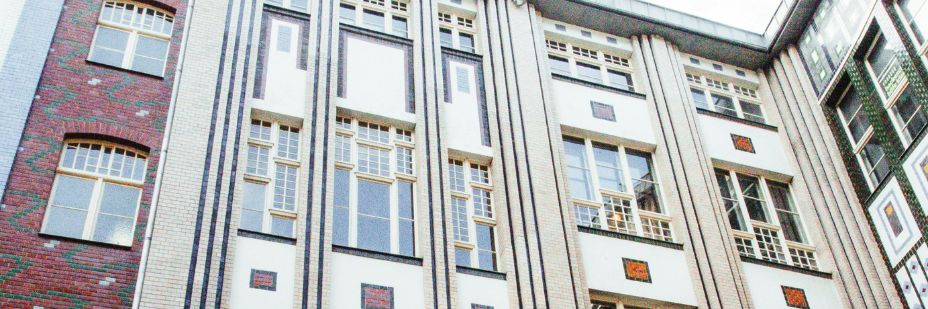
Jugendstil was not merely a branch of Art Nouveau but a reinterpretation deeply grounded in German culture. The term comes from “Jugend,” a Munich-based magazine founded in 1896 that quickly became a cultural hub for young creatives. It promoted innovative ideas in architecture, the decorative arts, and graphic design, standing in opposition to the traditional academic historicism that dominated the period.
In Germany, Art Nouveau found particularly fertile ground in furniture design, graphic arts, and architecture. Central to this vision was the concept of the “Gesamtkunstwerk”—the “total work of art”—in which every component of a home, from a door handle to a lamp, was conceived as part of a unified, coherent design system.
A Landmark Place: the Mathildenhöhe Art Colony
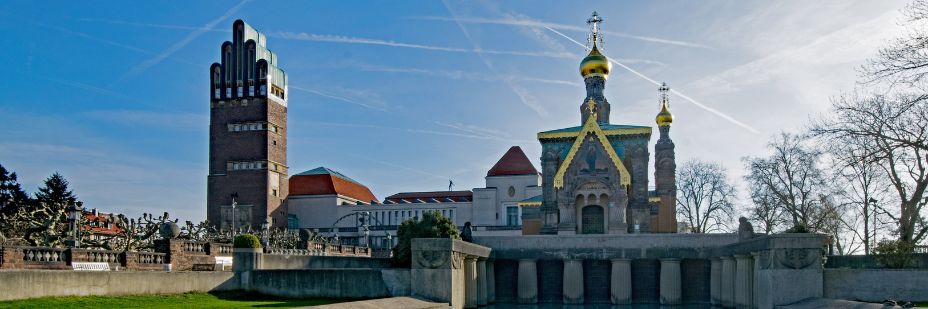
One of the most important centers of the Jugendstil movement was the Mathildenhöhe in Darmstadt, home to the artists’ colony founded in 1899 by Grand Duke Ernst Ludwig of Hesse. There, architects, designers, and craftsmen brought the idea of the Gesamtkunstwerk to life, creating exhibition pavilions and experimental houses conceived as fully integrated environments.
Among its most emblematic works is the Hochzeitsturm (Wedding Tower) by Joseph Maria Olbrich, which has become the colony’s enduring symbol. Mathildenhöhe represented the complete realization of Jugendstil ideals: not merely buildings, but holistic spaces that harmonized functional design, artistic expression, and everyday life. The site, enriched with squares, fountains, gardens, and public artworks, was recognized as a UNESCO World Heritage Site in 2021.
Art Nouveau in Austria: the Viennese Secession

In Austria, particularly in Vienna, Art Nouveau developed with distinctive strength and refinement, redefining the role of art in society. Here, the movement took the name Secessionist Style (“Secessionsstil”), after a group of artists including Gustav Klimt, Koloman Moser, Josef Hoffmann, and Joseph Maria Olbrich decided to break away from the official academy, which they saw as overly conservative.
The Secessionists sought to integrate art into everyday life, making it more harmonious and human, and to dissolve the rigid boundaries between fine and applied arts. Their ideas found fertile ground in a city undergoing rapid urban transformation and energized by a cultured bourgeoisie eager for innovation. As a result, Vienna became one of the leading centers of the new European aesthetic, a true urban laboratory of modernity.
The movement’s influence quickly spread across disciplines: from graphic design to furniture, from architecture to interior design, and to fabrics, stained glass, and everyday objects. This multidisciplinary vision led Hoffmann and Moser to establish the Wiener Werkstätte in 1903, one of Europe’s most influential applied arts workshops, which played a crucial role in spreading Jugendstil throughout the German-speaking world.
The group’s motto, inscribed on the façade of the Secession Building, perfectly encapsulates their vision: “Der Zeit ihre Kunst, der Kunst ihre Freiheit”—“To every age its art, to art its freedom.”
The Secession Palace: a Manifesto in Architecture
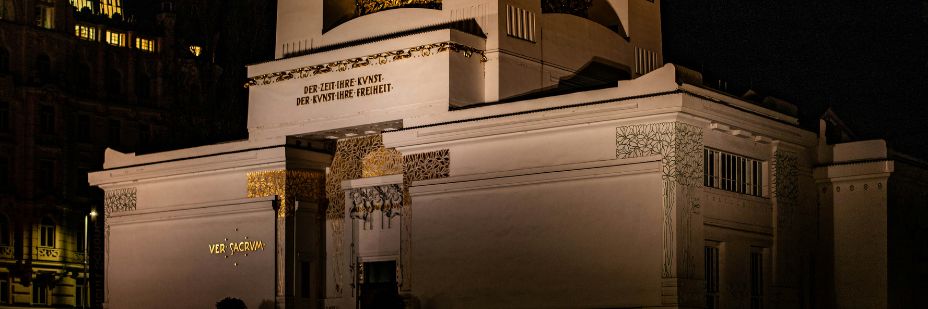
Built in 1898 and designed by Joseph Maria Olbrich, the Secession Palace is a cornerstone for understanding this artistic and cultural movement. More than an exhibition venue, it stands as an architectural manifesto, the first modern building in Central Europe devoted entirely to contemporary art.
The structure is instantly recognizable by its golden dome of laurel leaves, light, intricate, and gleaming above a façade defined by clean geometric forms and restrained elegance. This composition expresses the movement’s determination to break from historical styles and to create a new visual language for a new era.
At its heart lies a large exhibition hall conceived as a unified, luminous space illuminated by a skylight, one of the earliest deliberate uses of diffused zenithal light to enhance artworks within a museum setting. In the lower gallery, Gustav Klimt’s celebrated “Beethoven Frieze” adorns the walls, merging painting, architecture, and symbolism into a single, cohesive aesthetic experience.
Otto Wagner: the Architect Who Shaped Vienna’s Art Nouveau
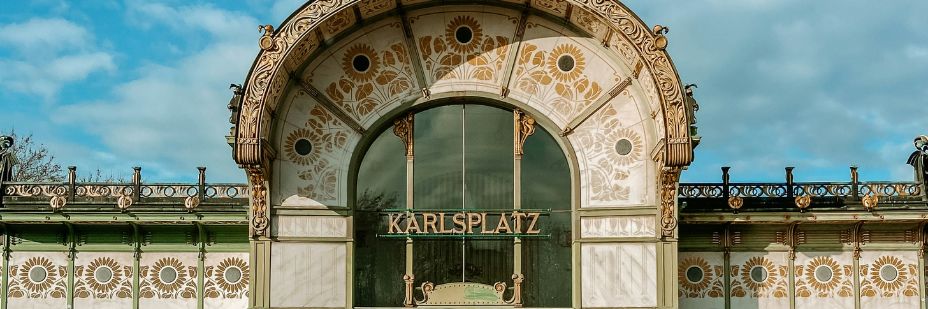
No discussion of Viennese Art Nouveau would be complete without Otto Wagner—a visionary architect who profoundly transformed the city’s appearance by fusing modernity and ornament with exceptional coherence. His work represents a masterful synthesis of function and decoration: not a “pure” Art Nouveau, but a mature and deliberate Jugendstil that looked confidently toward the future.
Among his most significant works are:
The Majolikahaus (Majolica House), Linke Wienzeile, 1898–1899: the façade is clad with ceramic tiles decorated with elegant floral motifs—a celebration of beauty combined with practicality, since the material is durable and easy to clean.
The Musenhaus (House of the Muses), built next to the Majolikahaus at the same time, features large circular medallions depicting muses and allegorical female figures by Koloman Moser, giving rhythm and symbolism to the façade.
The Stadtbahn Pavilions at Karlsplatz, 1898–1899: these metro station entrances, with steel structures clad in marble and refined floral detailing, embody Wagner’s balance between functionality, urban infrastructure, and artistic expression.
The Kirche am Steinhof (Church of St. Leopold), 1904–1907: one of Europe’s first truly modern churches, marked by a compact, symmetrical design dominated by a vast copper-clad dome. Its sober façade, adorned with gilded ornaments, angelic statues by Othmar Schimkowitz, and stained-glass windows by Koloman Moser, exemplifies spiritual elegance and structural clarity.
The Österreichische Postsparkasse (Austrian Postal Savings Bank), 1904–1912: perhaps Wagner’s most iconic and forward-looking work. Its strict modular design and bold use of aluminium featured in handles, cladding, and decorative elements contrast with the marble façade punctuated by visible rivets that emphasize the building’s structural rhythm and rational beauty.
Germany vs. Austria: Shared Ideals, Different Expressions
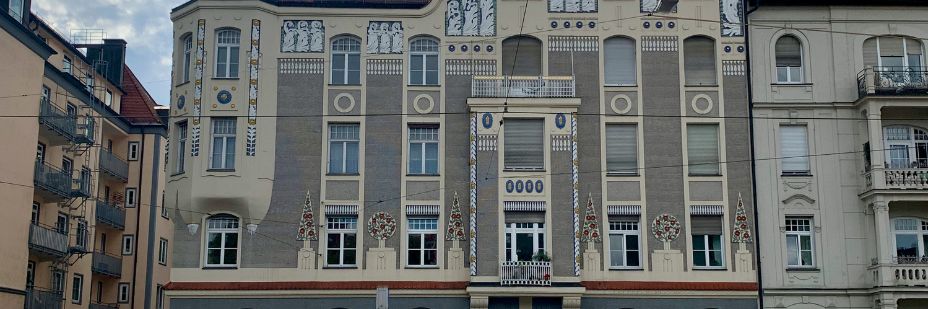
While Jugendstil in Germany was closely tied to the applied arts, such as magazines, furniture, and graphic design, its Austrian counterpart, particularly in Vienna, took on a more architectural and monumental form. The two movements were in constant dialogue: the Viennese and Munich Secessions influenced each other deeply, sharing a desire to unite art, design, and daily life.
However, Vienna offered something unique: an urban stage where modern art could extend beyond galleries and studios into the very fabric of the city: its stations, churches, and public buildings. This made Viennese Art Nouveau not merely an aesthetic trend, but a true cultural project of modernization, turning architecture into a living manifesto of beauty, innovation, and civic ambition.